Buying guide
Are Apple's entry models still worth it after this year's price rises?
The verdict
Worth it, if…
you buy the entry model in each line and skip the storage upgrade. The next model up costs $120 to $600 more, and the education and refurbished stores take some of this year's rises back off.
If you are buying from Apple this autumn, most Macs, iPads and iPhones cost more than they did in the spring. That makes the question of value sharper: which products give you the most for the price, and which extras quietly cost the most?
This issue works from the prices on Apple's US online store on 11 October 2026. It compares prices, reviews and resale values. It does not compare every feature, so treat it as a guide to where to look first.
First, what changed: two rounds of price rises
On 25 June, Apple raised prices on Macs and iPads. The cheapest iPad went from $349 to $449, a rise of nearly 29%, and the MacBook Neo went from $599 to $699, Bloomberg reported. Apple blamed the cost of memory chips, saying that "the rapid expansion of AI data centers has created an extraordinary surge in demand for memory and storage", according to the Associated Press.
iPhones followed on 9 September. The iPhone 17e, iPhone 17, iPhone Air and iPhone 16 each went up by $100, MacRumors reported.
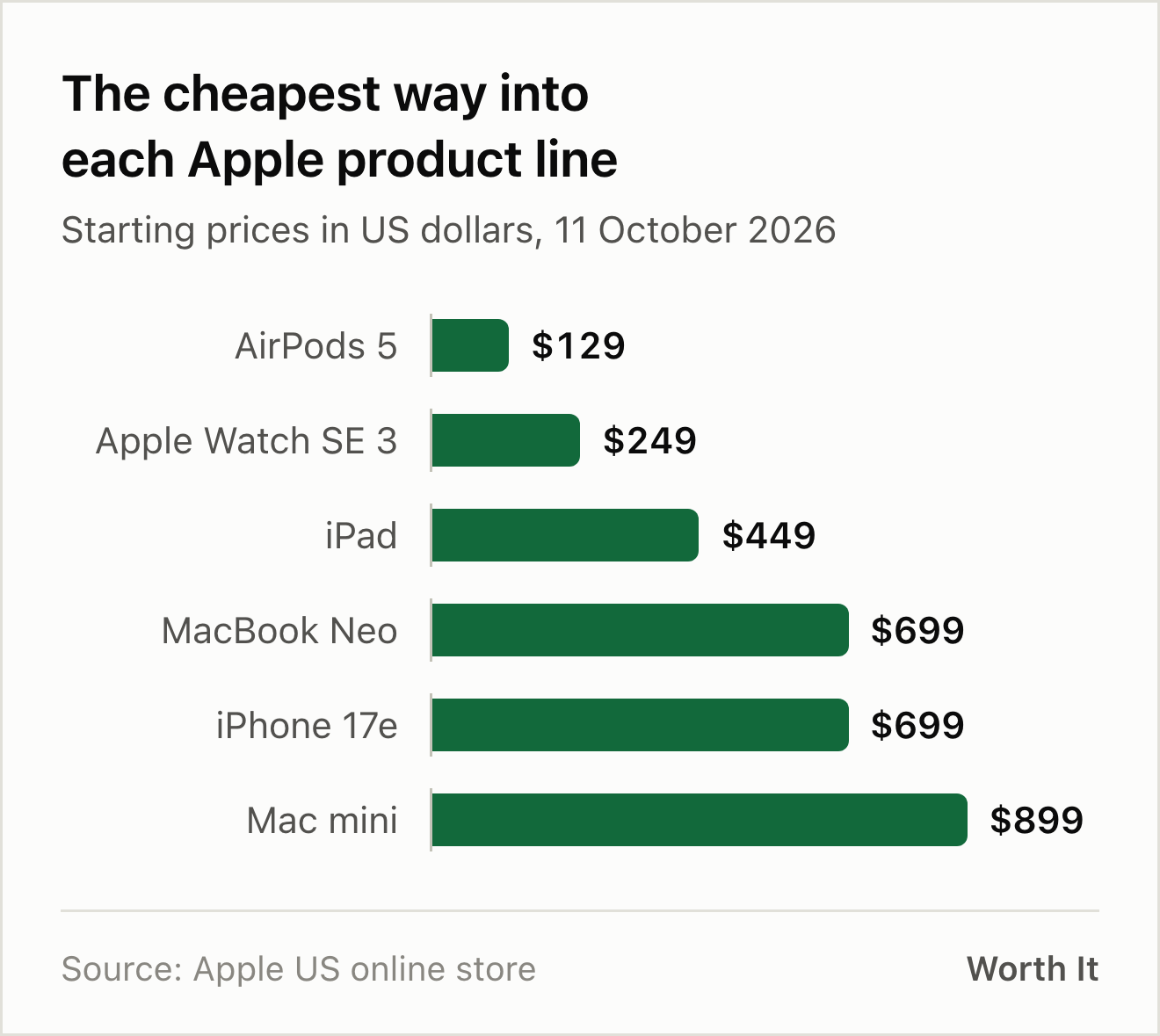
The chart below shows the cheapest model in each product line today.
The entry models, and what the step up costs
A useful way to judge value is to ask what the next model up costs, and whether you would notice the difference. Here is the gap in each line, from Apple's Mac, iPhone, iPad and Watch store pages.
- Laptop: MacBook Neo at $699. The MacBook Air starts at $1,299, which is $600 more.
- Desktop: Mac mini at $899. The iMac starts at $1,499, $600 more, though the iMac is an all-in-one with its own screen.
- Tablet: iPad at $449. The iPad Air starts at $749, $300 more.
- Phone: iPhone 17e at $699 with 256GB. The iPhone 17 starts at $899, $200 more for the same storage.
- Watch: Apple Watch SE 3 at $249. The Series 12 starts at $399, $150 more.
- Earphones: AirPods 5 at $129. AirPods Pro 3 cost $249, $120 more.
Two of these have recent review verdicts worth knowing. When the MacBook Neo launched, MacRumors' round-up of reviews found that "most reviews conclude that the laptop is still a great deal" for everyday work. The limits are real: 8GB of memory that cannot be upgraded, no backlit keys, and no Touch ID on the base model. Those reviews were written when it cost $599.
The new Mac mini is a closer call. BGR's review calls it "a great machine, but the value isn't quite as impressive" now that it costs $300 more than the previous model did at launch. The $899 buys 16GB of memory and 256GB of storage, with no screen or keyboard. BGR still recommends it for people who already own those.
One oddity: the older iPhone 16 is listed at $799, which is $100 more than the newer 17e. Compare those two carefully before paying extra for the older phone.
The cheapest iPhone is not always the cheapest to own
Sticker price is only half of what a phone costs you. The other half is what you get back when you sell or trade it in.
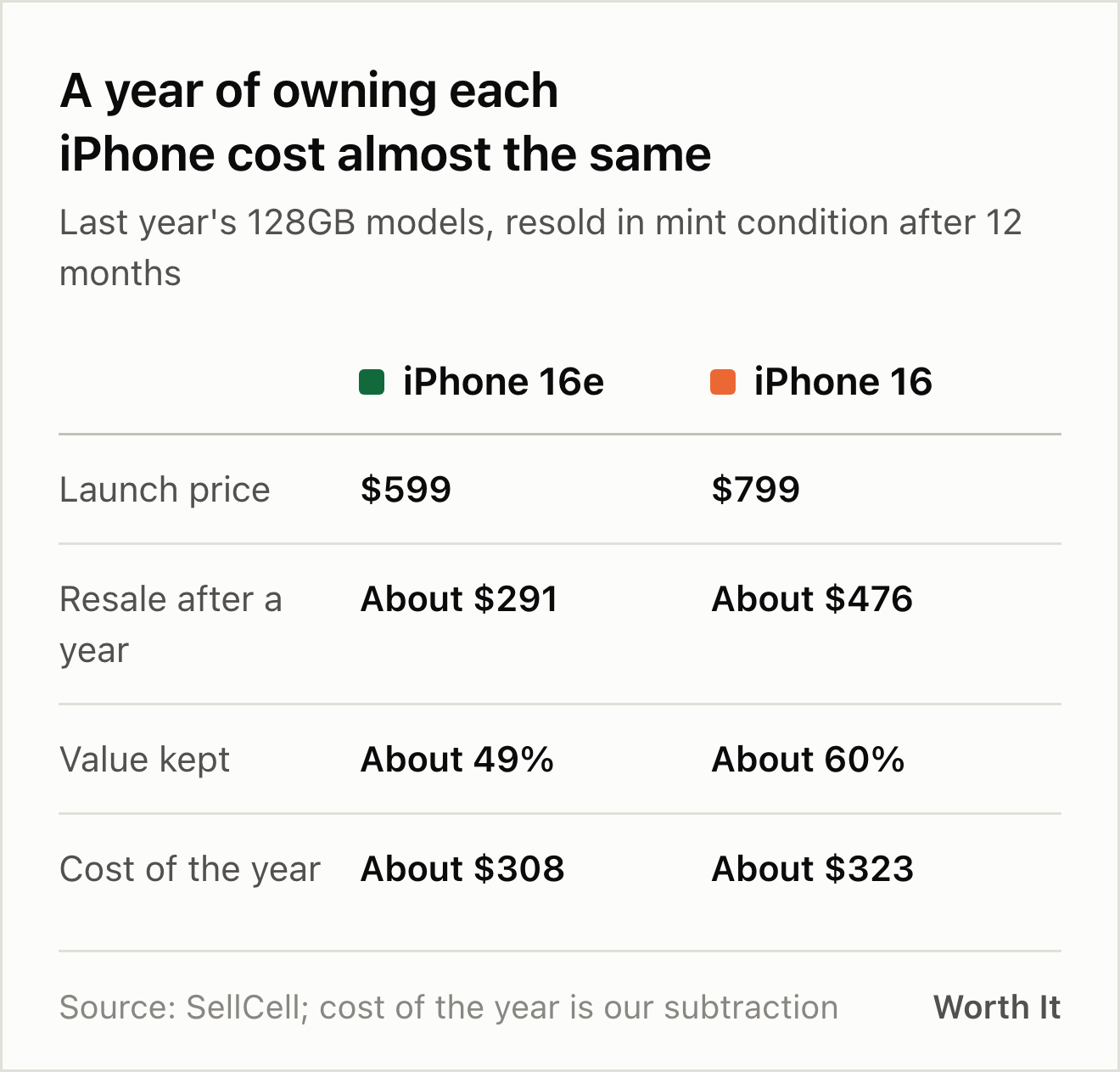
The resale site SellCell tracked last year's models for 12 months. The budget iPhone 16e, launched at $599, was worth about $291 a year later. The standard iPhone 16, launched at $799, was worth about $476. So a year with the cheaper phone cost about $308, and a year with the dearer one cost about $323: a difference of $15.
Both iPhones did better than SellCell's comparable Samsung. The Galaxy S24 FE kept roughly 36% of its price after a year, against 49% for the iPhone 16e. Google's Pixel 8a kept about 48%, close to the 16e.
Some cautions. These are SellCell's own figures for phones in mint condition, and the company does not publish its sample size. They describe last year's models at last year's prices, so this year's may behave differently. And the sum only works if you actually sell the phone.
Two ways to pay less, and two ways to overpay
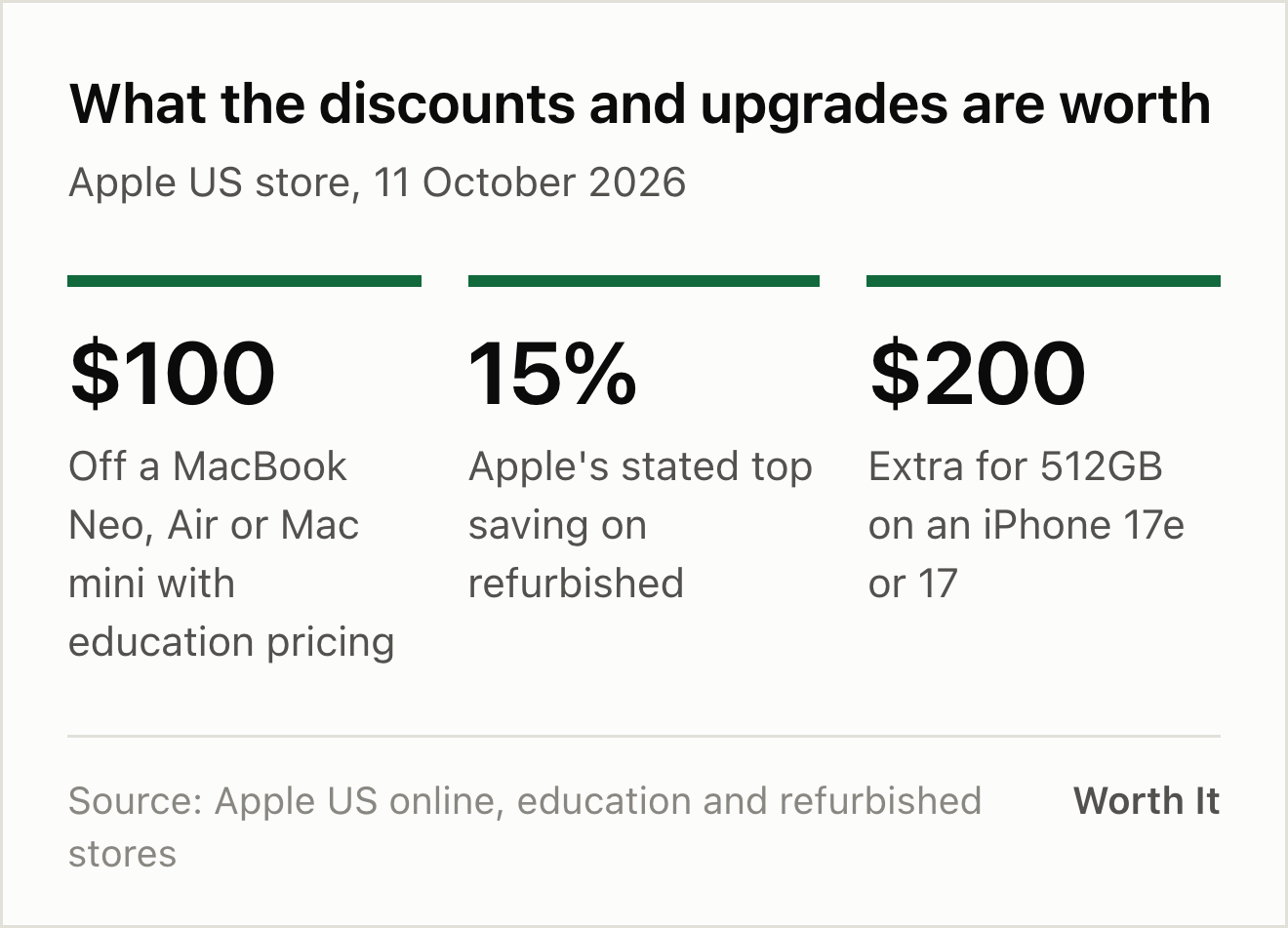
- Education pricing. Apple's education store takes $100 off the MacBook Neo, MacBook Air and Mac mini, which puts the Neo back at its pre-rise $599. It is open to college students, their parents, and teachers and staff at any level. The saving on the basic iPad is smaller: $20.
- Refurbished from Apple. Apple says its certified refurbished products save up to 15% and carry a one-year warranty. One example on sale today: a 24-inch iMac at $1,269, $230 below its new price. Stock changes daily.
The first way to overpay is storage. Going from 256GB to 512GB adds $200 to either the iPhone 17e or the iPhone 17. On the 17e, that is about 29% more for the same phone.
The second is to mistake leasing for buying. Apple's store shows low monthly "lease" prices beside many products. Apple's own small print describes this as "a consumer lease, not a purchase or loan", and says you will not own the device at the end unless you pay to exercise a purchase option.
Sources
- Buy Mac, Apple US online store, read 11 October 2026
- Buy iPhone, Apple US online store, read 11 October 2026
- Buy iPad, Apple US online store, read 11 October 2026
- Buy Apple Watch, Apple US online store, read 11 October 2026
- Buy Mac, education store, Apple, read 11 October 2026
- Buy iPad, education store, Apple, read 11 October 2026
- Certified Refurbished, Apple, read 11 October 2026
- Refurbished Mac, Apple, read 11 October 2026
- Apple hikes Mac, iPad prices on memory shortage, Bloomberg via The Spokesman-Review, 25 June 2026
- Apple increases prices for Macs and iPads, blaming memory chip shortage fueled by AI, Associated Press via PBS NewsHour, 26 June 2026
- Apple Raises Prices of iPhone 16, iPhone 17, iPhone Air, and iPhone 17e, MacRumors, 9 September 2026
- MacBook Neo review round-up, MacRumors, 10 March 2026
- Mac mini (M6) review, BGR, 9 October 2026
- iPhone 17e resale study, SellCell, updated 3 March 2026
Spotted a mistake? See corrections.